
July 9, 2026
QUICK ANSWER
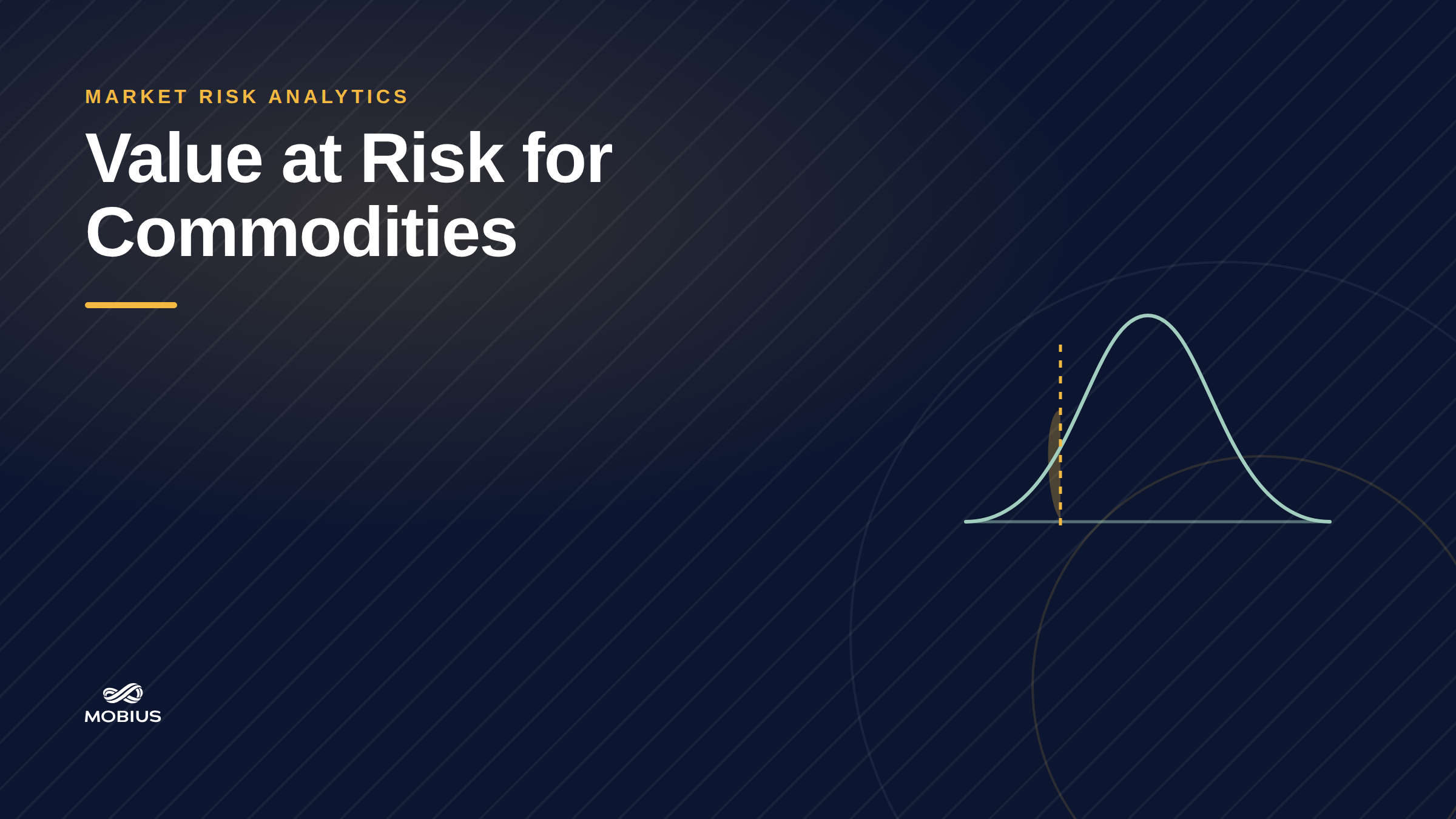
Value at Risk (VaR) estimates the maximum loss a commodity portfolio is likely to suffer over a defined period at a chosen confidence level. A "95% one-day VaR of $2M" means there is a 5% chance of losing more than $2M in a single day. It is the standard single-number summary of market risk.
VaR gives boards, risk committees, and lenders one comparable figure for "how much could we lose." It is not a worst-case number and it is not a forecast — it is a probabilistic boundary that makes risk across desks, commodities, and time horizons directly comparable.
What is Value at Risk (VaR)?
VaR answers a specific question: over the next day or week, at a stated confidence level such as 95% or 99%, what loss will we not exceed? Three inputs define it — the time horizon, the confidence level, and the portfolio's positions and price behavior. Change any one and the number changes, which is why stating all three matters.
How is VaR calculated?
There are three standard methods, each trading simplicity against accuracy for complex portfolios.
[ TABLE IMAGE — in the Webflow editor, drop "var-methods.png" here and delete this line ]
What VaR does not tell you
VaR describes the threshold, not what lies beyond it. A 99% VaR says nothing about how bad the worst 1% of days get — that is tail risk, better captured by expected shortfall (CVaR) and, above all, by stress testing against specific scenarios. Used alone, VaR can create false comfort; used with stress tests, it is a powerful discipline.
Why VaR matters for commodity firms
VaR anchors the risk limits in a commodity hedging policy, standardizes board and lender reporting, and lets a firm compare exposure across gas, power, crude, and refined products on one scale. It is only as good as the data and models behind it, which is why the calculation belongs in a robust system rather than a spreadsheet — see CTRM software.
How Mobius Risk Group helps
Mobius builds VaR and limit frameworks into clients' risk programs and delivers them through RiskNet, our trade and risk analytics platform — pairing the number with the stress testing and governance that make it meaningful.
Frequently Asked Questions
What does a 95% VaR mean?
There is a 95% chance losses stay within the VaR figure over the period, and a 5% chance they exceed it.
Is VaR a worst-case loss?
No. It is a threshold at a confidence level; losses beyond it can be larger. Pair VaR with stress testing for tail events.
Which VaR method is best?
It depends on the portfolio. Historical and parametric methods are simple; Monte Carlo handles options and complex books but costs more to run.
Subscribe to receive the latest Mobius Research & updates