

February 2, 2026
QUICK ANSWER
A commodity hedging policy is a written document that defines what a company is trying to protect, which instruments it may use, how much of its exposure to hedge, and who has authority to transact. It turns hedging from a series of ad-hoc decisions into a governed program that lenders, boards, and auditors can rely on.
Most hedging mistakes are governance failures, not market calls — an over-hedged position, an unapproved structure, or a trade no one can explain later. A hedging policy prevents them by writing the rules down before any trade is placed.
Why does a company need a hedging policy?
Without a policy, hedging decisions drift with whoever is making them and whatever the market is doing. A written policy fixes the objective, sets limits, and creates an audit trail — which is what turns a set of trades into a defensible program and often what lenders and boards require.
What should a commodity hedging policy contain?
A complete policy covers a handful of sections, each with a clear owner. The table below breaks them down.
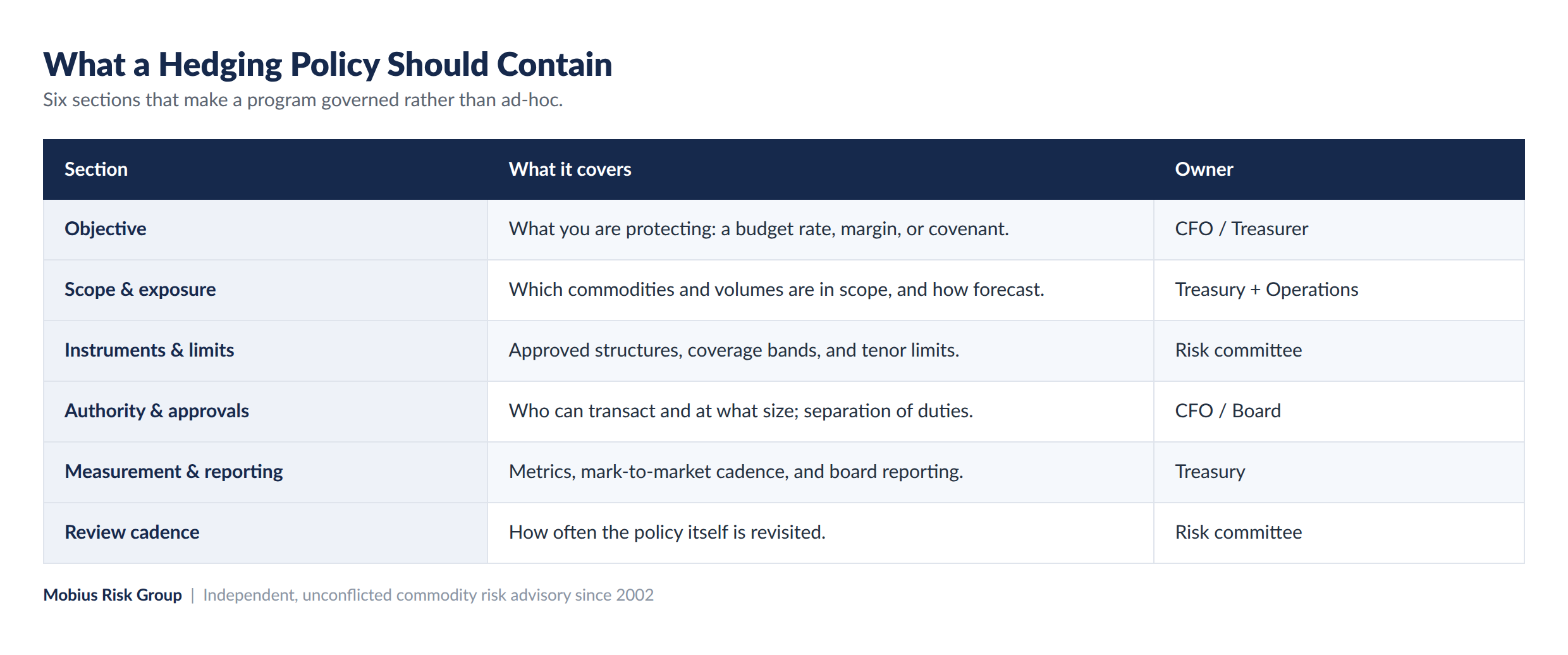
The first section is the most important: the objective. Whether you are protecting a budget rate, a margin, or a covenant determines every other choice in the document.
Who owns the policy?
Ownership sits with finance — the CFO or treasurer sets the objective and limits, a risk committee approves instruments and reviews the program, and operations informs the exposure forecast. Clear separation between who decides, who transacts, and who reports keeps the program controlled.
How Mobius Risk Group helps
As an unconflicted advisor, Mobius Risk Group helps companies write and maintain hedging policies, size coverage with M(β)risk™ analytics, and report against the objective using RiskNet™ — without earning a spread on the trades the policy governs.
Frequently Asked Questions
What is a commodity hedging policy?
A written document defining what a company hedges, which instruments it may use, coverage and tenor limits, who has authority, and how the program is measured and reported.
What is the most important part of a hedging policy?
The objective — what you are protecting. A budget rate, margin, or covenant each points to different instruments and coverage levels.
Who should own a hedging policy?
Finance owns the objective and limits; a risk committee approves and reviews; operations supplies the exposure forecast. Duties are separated for control.
Subscribe to receive the latest Mobius Research & updates