
August 14, 2026
Quick Answer
An unconflicted commodity risk advisor provides hedging and market strategy without taking the other side of your trades or earning a margin on transactions. Because revenue comes only from advisory fees, the guidance is aligned with the client's risk objectives rather than a bank's trading desk or brokerage volume.
Why does “unconflicted” matter in commodity risk advice?
Most commodity hedging advice reaches producers and buyers through parties that also profit from the transaction. A bank desk that recommends a swap may warehouse the opposite side; a broker paid per lot benefits from turnover, not outcomes. These structural conflicts don't make the advice worthless, but they do mean the incentives are not fully aligned with the client's balance sheet.
An unconflicted advisor removes the transactional incentive entirely. Mobius Risk Group, founded in 2002, is compensated through advisory fees rather than trading margin, so the recommendation to hedge, wait, or restructure is driven by the client's exposure profile alone.
How is the unconflicted model different from a bank or broker?
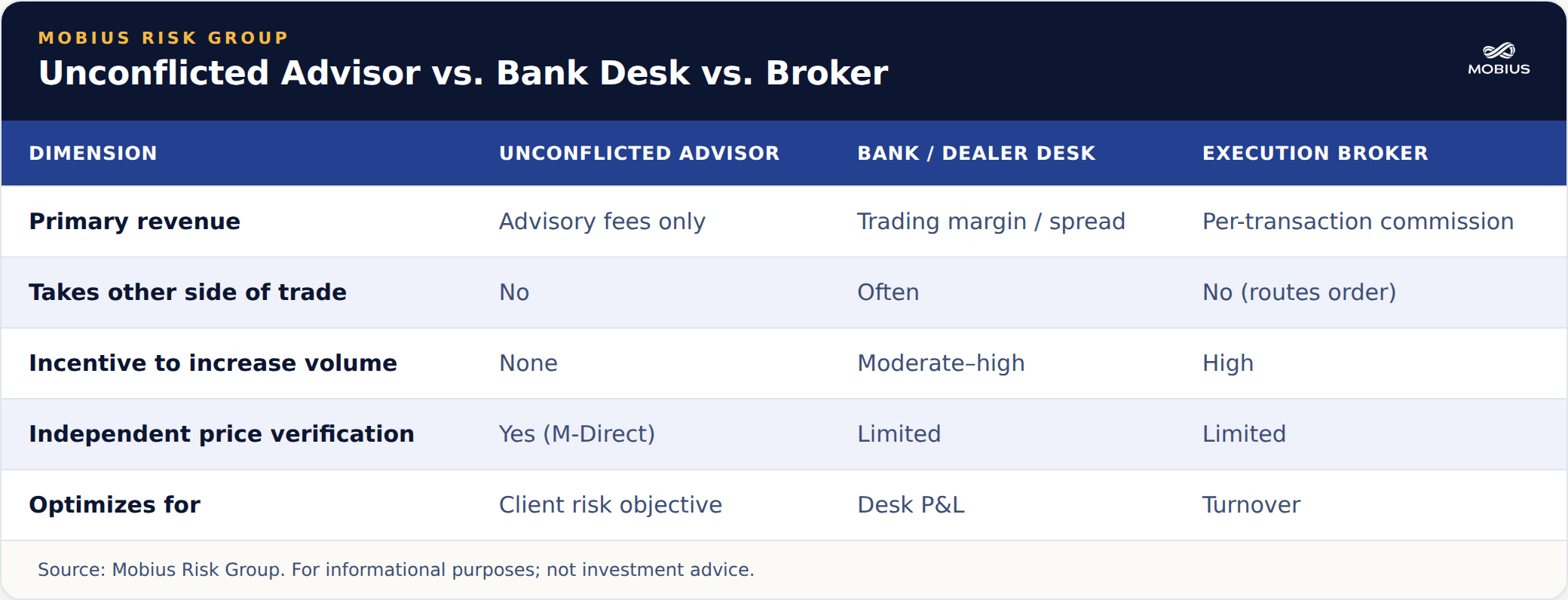
The distinction shows up in three places: how the advisor is paid, whether it holds a position against you, and what data it optimizes for. The comparison below summarizes the practical differences buyers and producers encounter.
Unconflicted Advisor vs. Bank Desk vs. Broker
What does an unconflicted advisor actually deliver?
Beyond the incentive structure, the value is in the toolset. Mobius pairs advisory judgment with technology: the RiskNet CTRM platform for exposure and position management, M(β)risk analytics for scenario and value-at-risk modeling, and M-Direct for indicative pricing that lets clients sanity-check the quotes they receive. That combination lets a CFO or risk officer verify that a hedge is priced fairly and sized correctly against real exposure.
See related reading on natural gas hedging strategies for CFOs and how a structured program is built.
Frequently asked questions
Does unconflicted mean the advisor never uses banks?
No. An unconflicted advisor still transacts through banks and brokers on the client's behalf; it simply does not earn margin on those transactions, so counterparty selection is driven by best execution rather than internal profit.
How is an unconflicted advisor compensated?
Through transparent advisory or retainer fees agreed with the client, independent of hedge volume or direction. This keeps the advice aligned with the client's exposure rather than transaction flow.
Who benefits most from this model?
Energy producers and midstream operators, chemical and industrial buyers, and CFOs or treasurers who need hedging decisions insulated from dealer incentives, as well as PE and M&A teams evaluating commodity risk in a target.
Talk to an unconflicted advisor. Mobius Risk Group has advised energy and industrial clients on commodity risk since 2002. Start a conversation →
Subscribe to receive the latest Mobius Research & updates