
August 25, 2026
Quick answer: Renewable natural gas (RNG) earns most of its value from environmental attributes, not the gas itself. Under the federal Renewable Fuel Standard, RNG used as transport fuel generates D3 (cellulosic) RINs; in California and other states, it also earns Low Carbon Fuel Standard (LCFS) credits based on carbon-intensity scores. Both trade in volatile markets, so an RNG project's economics depend heavily on RIN and LCFS credit prices.
Why do RNG projects depend on environmental credits?
The methane in renewable natural gas is chemically identical to fossil gas, so on the commodity market alone it earns roughly the same price. The economics that justify capturing methane from dairies, landfills, and wastewater come from environmental attributes — tradable credits that reward low-carbon fuel. For most RNG projects used in transportation, these credits dwarf the value of the gas itself, which is exactly why credit-price risk is the dominant exposure.
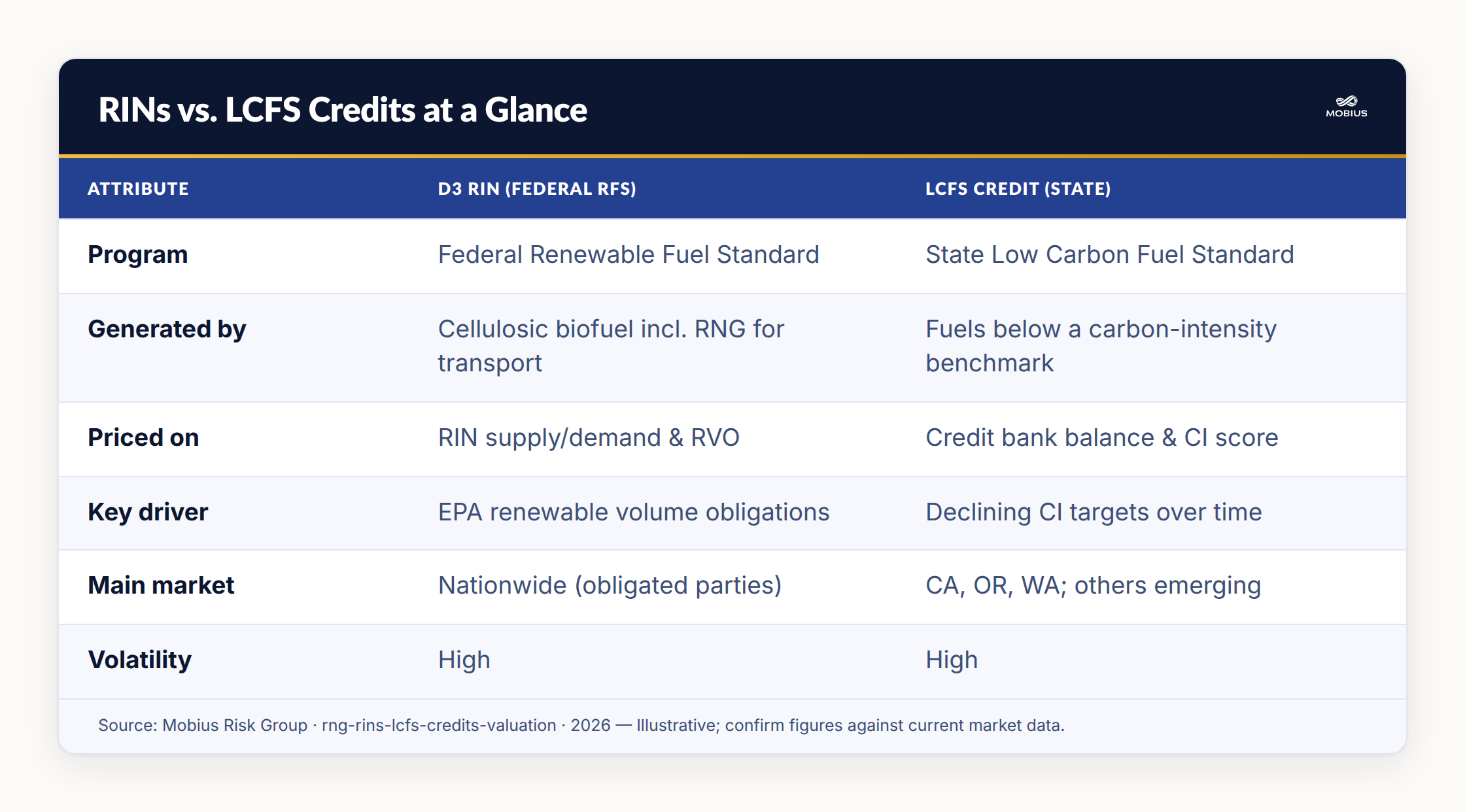
RINs vs. LCFS Credits at a Glance
How are D3 RINs valued?
Under the federal Renewable Fuel Standard, RNG dispensed as vehicle fuel (typically as CNG/LNG) generates D3 cellulosic Renewable Identification Numbers. Obligated parties — refiners and importers — must retire RINs to meet EPA's annual Renewable Volume Obligations. D3 RIN prices move with that supply-and-demand balance, EPA rulemaking, and the cellulosic waiver credit. Because volumes and policy shift year to year, D3 RIN values can swing sharply.
How are LCFS credits valued?
California's Low Carbon Fuel Standard — and similar programs in Oregon and Washington — issue credits to fuels whose carbon intensity (CI) falls below an annually declining benchmark. The lower a project's verified CI score, the more credits per unit of energy it earns; dairy and landfill RNG can post very low or even negative CI scores. Credit prices depend on the balance between credits and deficits in the program bank and on how fast the CI targets tighten. A large credit bank can depress prices even when long-term targets are stringent.
How do you manage RIN and LCFS price risk?
Because two volatile credit streams sit on top of a commodity price, RNG revenue is unusually exposed. Developers and offtakers manage it with forward sales and offtake agreements that fix credit prices, careful CI-pathway certification to protect credit generation, and integrated exposure tracking that values the gas, the RINs, and the LCFS credits together. Mobius helps RNG developers and buyers model combined exposure and structure offtake and hedges so a swing in one credit market doesn't sink the project.
Related reading from Mobius Risk Group
- What Is Renewable Natural Gas (RNG) and How Is It Priced?
- RNG vs. Traditional Natural Gas: What CFOs Need to Know
- Natural Gas Hedging Strategies for CFOs and Treasurers
Frequently asked questions
What is the difference between a RIN and an LCFS credit?
A RIN is a federal Renewable Fuel Standard credit tied to renewable fuel volume; RNG for transport earns D3 (cellulosic) RINs. An LCFS credit is a state credit earned by beating a carbon-intensity benchmark. Many RNG projects earn both simultaneously.
Why is RNG worth more than regular natural gas?
The gas itself is nearly identical in price. RNG's premium comes from environmental credits — D3 RINs and LCFS credits — that reward low-carbon transportation fuel. These attributes often exceed the commodity value of the gas.
What makes RIN and LCFS prices volatile?
RIN prices move with EPA renewable volume obligations and cellulosic supply; LCFS prices move with the program's credit-versus-deficit bank and the pace of tightening carbon-intensity targets. Policy changes in either program can move prices sharply.
Can you hedge RNG credit revenue?
Yes, primarily through forward sales and offtake agreements that fix credit prices, plus protecting carbon-intensity certification. Because liquidity in these credit markets is limited, structuring is more bespoke than for exchange-traded commodities.
Mobius Risk Group is an independent, unconflicted commodity risk advisor. This article is educational and not financial or accounting advice; confirm figures and rules against current market data and your own advisors.
Subscribe to receive the latest Mobius Research & updates