
July 27, 2026
Quick answer: A commodity management system centralizes trade capture, positions, valuation and risk reporting across every commodity a business touches. For a multi-commodity firm the deciding factor is whether one platform can hold gas, power, crude, refined products and any agriculturals or metals in a single netted book — or whether you end up running a separate system per commodity.
Most firms do not set out to run several commodity systems. They buy one for gas, add a spreadsheet for power when the desk opens, inherit something else with an acquisition, and three years later the position report is assembled by hand on Monday mornings. The question this page answers is what a commodity management system is supposed to do, and what changes about that answer when you trade more than one commodity.
What is a commodity management system?
A commodity management system is the system of record for commodity activity. It captures deals — physical and financial — tracks the resulting positions as prices move, values those positions against market curves, monitors limits and counterparty credit exposure, and produces the reporting that risk, treasury, accounting and leadership work from.
The category is also sold as CTRM and as ETRM software, and the labels overlap more than they separate. What matters is whether the system can hold your contracts as they are actually written, value them the way your accounting team values them, and show the answer in one place.
What does a commodity management system actually do?
The functional core is consistent across platforms:
- Trade and deal capture for physical and financial transactions, including capture by API or upload rather than only by hand.
- Position tracking at portfolio, commodity, book and site level.
- Valuation and mark-to-market against forward curves, with the basis and location differentials each commodity needs.
- Risk analytics and scenario analysis to test a hedge before it is placed.
- Limits, credit and compliance monitoring, including the reporting regimes the firm falls under.
- Reporting shaped for risk, treasury, accounting and executive audiences from the same underlying data.
What should a multi-commodity firm look for?
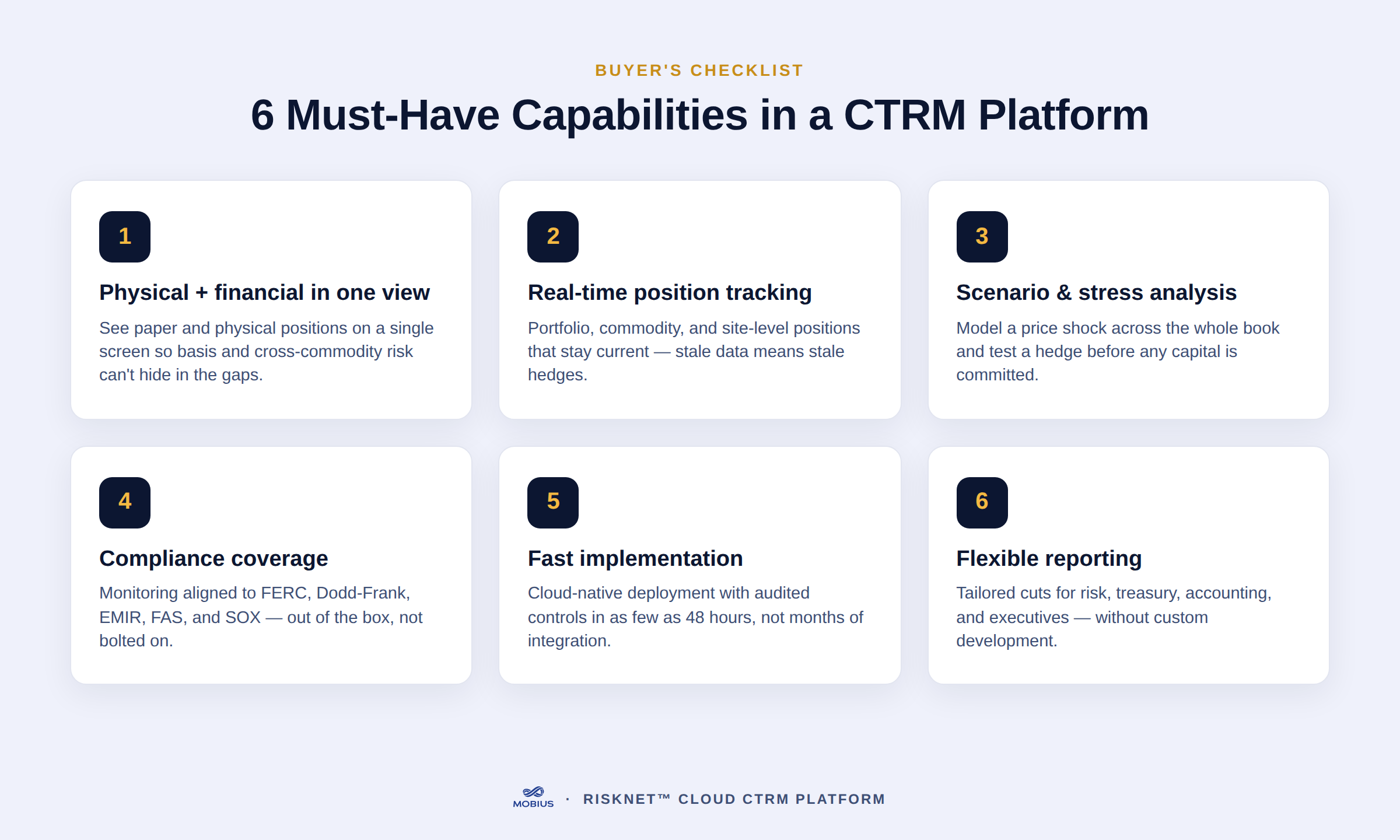
Running several commodities changes which of those capabilities decides the purchase. Five things separate a platform that will hold a multi-commodity book from one that will hold several books side by side.
A single netted book across commodities. Gas, power, crude, refined products and any agriculturals or metals should sit in one book of record, netting where they genuinely offset rather than being summed in a spreadsheet afterwards. This is the capability that most often turns out to be partial, and it is the one worth testing first.
Per-commodity curve and basis handling. Cross-commodity does not mean uniform. Power needs granularity and shaping that gas does not; crude and refined products need grade and location differentials; agriculturals carry their own seasonality and quality adjustments. A platform that forces every commodity through one curve model will be approximately right and specifically wrong.
One set of limits and one credit exposure. Counterparty credit is a firm-level number, not a desk-level one. If a counterparty trades with you in three commodities, you need the aggregate exposure in one view, with limits defined once and enforced across all of them.
The ability to add a commodity without a re-implementation. Ask what happens when you open a new commodity in eighteen months. If the answer is a new module, a new instance or a scoped project, you have found a real cost that will not appear in the first quote.
Consolidated reporting. One position report, one exposure report, one P&L attribution, covering everything. If reporting is per-commodity and assembled downstream, the system has not actually consolidated anything — it has centralised the data entry and left the hard part with you.
Commodity management system vs CTRM vs ETRM: are they the same thing?
Broadly, yes. The three terms describe the same category of software.
CTRM — commodity trading and risk management — is the widest label, covering energy alongside metals, agriculturals and softs. ETRM — energy trading and risk management — is the same category framed around energy commodities, and the term is common wherever gas and power are the core of the book. Commodity management system is the phrase used more often by industrial and corporate buyers whose commodity activity supports a physical business rather than a trading desk.
The differences are breadth and origin, not technology. Most platforms marketed under one label will demonstrate against the others. Compare capabilities against your own book and ignore the label. If you want the distinction in more detail, see CTRM vs ETRM software.
How do you choose between platforms?
Evaluate against your own commodities rather than the vendor’s demo set. Bring real deals, including the awkward ones, and have them booked in front of you. Pick a position and date where you already know the mark and ask the system to reproduce it. Ask for references from firms with a comparable commodity mix, not simply a comparable size.
Then separate what the platform does from what the rollout costs. Core onboarding can be fast; integrations, data migration and customization are what extend a full implementation. Scope those explicitly and in writing before you sign.
Where does Mobius sit in this?
A disclosure worth making plainly: Mobius is an independent, unconflicted advisor that does not take the other side of client trades, and Mobius also builds RiskNet — a commercial interest in the category being described. RiskNet is CTRM software that holds multiple commodities in a single book. The RiskNet core platform is onboarded and ready to use in as little as 48 hours across multiple commodities, with audited controls. Integrations — price feeds, ETRM/ERP, banks and exchanges — data migration and customization are what extend a full rollout. It is delivered self-serve, supported or managed, depending on how much of the running you want to keep in house.
The criteria above apply whether or not you choose RiskNet. They are the criteria we would expect a buyer to hold us to.
Frequently asked questions
What is a commodity management system?
A commodity management system is the system of record for a firm’s commodity activity. It captures physical and financial trades, tracks positions as prices move, values those positions against market curves, monitors limits and credit exposure, and produces the reporting that risk, treasury, accounting and leadership rely on. It replaces the spreadsheet layer that most firms start with once positions grow beyond what one person can reconcile.
What is the best commodity management system for a multi-commodity firm?
The best system for a multi-commodity firm is the one that holds every commodity you trade in a single netted book, handles each commodity’s own curve and basis conventions natively, and lets you add a commodity without re-implementing. Test that directly: ask a vendor to load two unlike commodities during evaluation and produce one consolidated position and one consolidated credit exposure. Platforms that need a separate instance or module per commodity will show it at that point.
Is a commodity management system the same as a CTRM?
Largely, yes. Commodity management system, CTRM and ETRM describe the same category of software under three labels. CTRM (commodity trading and risk management) is the broad term; ETRM (energy trading and risk management) is the same thing framed around energy; commodity management system is the phrase more often used by industrial and corporate buyers. The differences are breadth and origin rather than technology, so compare capabilities rather than the label.
Subscribe to receive the latest Mobius Research & updates