
August 11, 2026
Quick answer: Commodity hedge accounting is an election under ASC 815 that lets a company match the gain or loss on a hedge with the exposure it offsets, smoothing earnings instead of running derivative swings through income each quarter. It requires formal documentation, effectiveness testing, and disciplined treasury processes to qualify.
Why do CFOs care about hedge accounting?
A hedge can be economically perfect and still create accounting noise. Without hedge accounting, a derivative is marked to fair value every reporting period and those changes flow straight through the income statement—even though the offsetting physical exposure is not yet recognized. The result is earnings that swing with the forward curve, which analysts dislike and boards question.
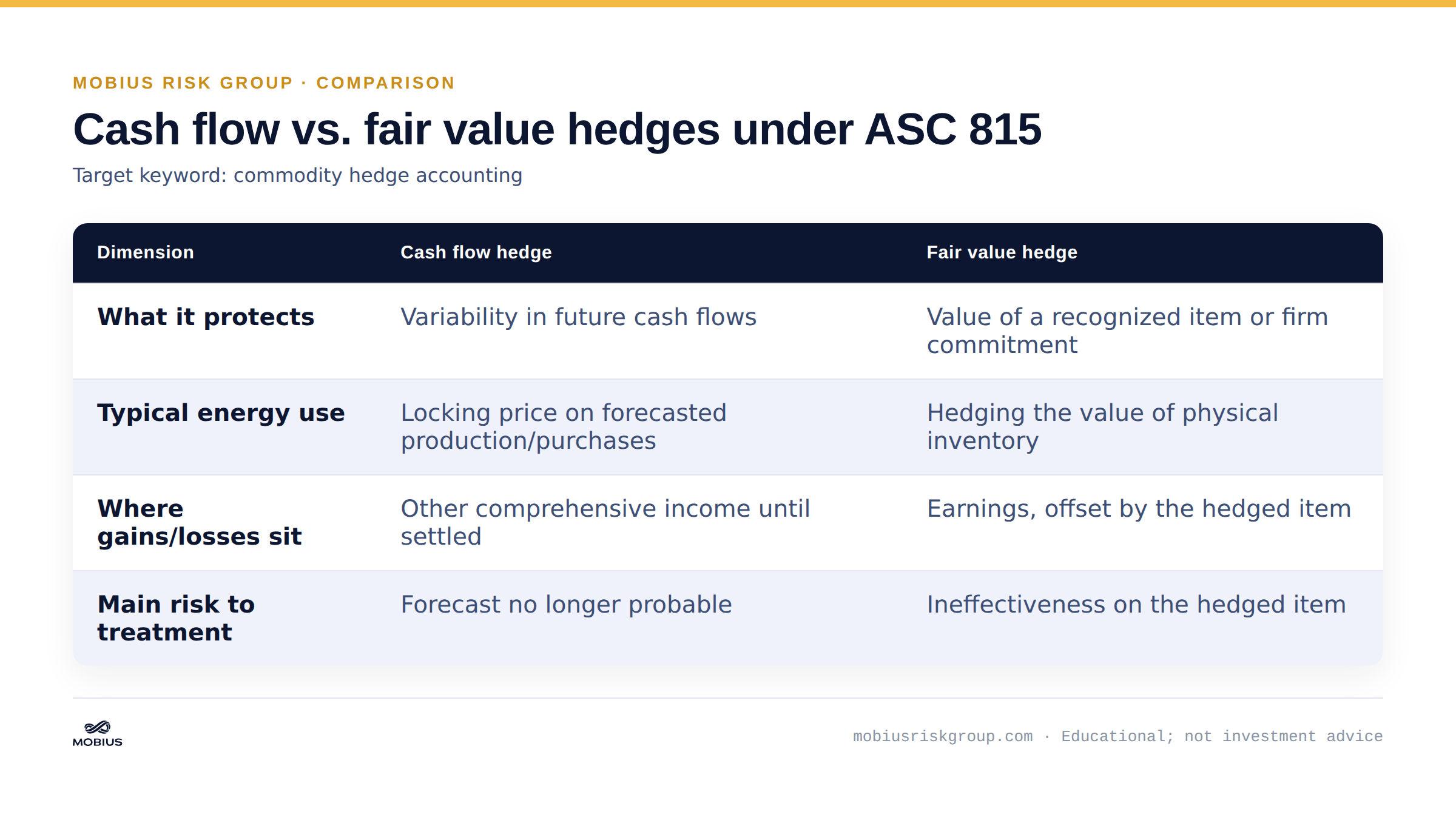
Hedge accounting under ASC 815 exists to solve that mismatch. When a treasury team qualifies, the effective portion of a cash flow hedge sits in other comprehensive income until the hedged transaction hits earnings, so reported results reflect the economics of the business rather than the mark-to-market of open positions.
What is the difference between a cash flow and a fair value hedge?
The two designations answer different questions. A cash flow hedge protects against variability in future cash flows—for example, a producer locking the price it will receive for next year’s gas. A fair value hedge protects against changes in the value of a recognized asset, liability, or firm commitment, such as inventory already on the books.
Choosing the wrong designation, or failing to document it at inception, is one of the most common reasons companies lose hedge accounting treatment and restate. The election is not retroactive: the paperwork must exist before or at the moment the hedge is put on.
What does it take to qualify under ASC 815?
Qualification is a process, not a one-time checkbox. It starts with contemporaneous documentation of the hedging relationship, the risk being hedged, and the method for assessing effectiveness. From there, the relationship must be tested—prospectively and retrospectively—to confirm the hedge is expected to be, and continues to be, highly effective.
The 2017 FASB update (ASU 2017-12) simplified parts of this for many commodity hedgers, but the discipline still lives or dies on data quality. Teams that manage exposures in spreadsheets tend to struggle with the audit trail; those running a commodity trading and risk management system capture positions, valuations, and effectiveness results in one place.
How do treasury teams get hedge accounting wrong?
The failure modes are predictable: documentation drafted after the trade, effectiveness testing that is not repeatable, hedge ratios that drift, and forecasts of the hedged transaction that turn out to be unsupportable. Any of these can force a company to de-designate and recognize volatility it went to great lengths to avoid.
This is where independent advice matters. Mobius helps energy producers and industrial buyers design hedging programs that are economically sound and operationally auditable—pairing Strategy Direct advisory with RiskNet, its CTRM platform, so the accounting treatment survives contact with the auditors. Specific policy elections should always be confirmed with the company’s accounting team.
Related reading from Mobius Risk Group
Continue with natural gas hedging strategies; what an energy hedging advisor does; a CTRM platform.
Frequently asked questions
Is hedge accounting required?
No. Hedge accounting is an elective treatment. A company can hedge economically without it, but then derivative fair-value changes flow through earnings each period. Companies elect it to reduce reported earnings volatility, not because a hedge requires it.
What is ASC 815?
ASC 815 is the U.S. GAAP standard governing derivatives and hedging. It sets the criteria for when and how a company can apply hedge accounting, including documentation and effectiveness-testing requirements for cash flow and fair value hedges.
Can a CTRM system help with hedge accounting?
Yes. A CTRM platform centralizes positions, valuations, and effectiveness testing, producing the repeatable audit trail ASC 815 demands. It reduces the manual, spreadsheet-driven errors that often cause companies to lose hedge accounting treatment.
Subscribe to receive the latest Mobius Research & updates