
August 11, 2026
Quick answer: Commodity price risk in energy M&A is the danger that oil, gas, or power prices move between signing and integration, changing what an asset is worth. Buyers and sellers manage it with independent valuation, deal-contingent hedges, collars, and clear risk allocation in the purchase agreement—ideally advised by an unconflicted party.
Why does commodity price risk matter in an energy acquisition?
An energy acquisition is, at its core, a bet on future cash flows—and those cash flows are driven by the price of crude, natural gas, NGLs, or power. When a private-equity sponsor or strategic buyer signs a deal, the valuation model assumes a forward curve. If prices fall 15-20% between signing and closing, the equity value underpinning the purchase price can evaporate even though nothing about the assets themselves has changed.
This timing gap is what makes commodity risk different from ordinary operational risk in a transaction. Diligence can confirm reserves, contracts, and liabilities, but it cannot freeze the market. The period between an executed purchase and sale agreement (PSA) and a close—often 60 to 180 days for energy deals that require regulatory or lender approvals—is precisely when an unhedged buyer is most exposed.
Who bears the price risk between signing and closing?
Risk allocation is negotiated, not assumed. A seller who has already hedged production may want those hedges to travel with the asset; a buyer may prefer to unwind and re-strike them to match its own view. The PSA typically addresses hedge novation, material adverse change (MAC) clauses, and purchase-price adjustments tied to realized prices or working capital.
In practice, the party with the clearest, independently validated view of exposure tends to negotiate from strength. That is why acquirers increasingly bring in a third-party risk advisor to quantify the mark-to-market of existing hedges and model how the combined book behaves under stress—work that Mobius supports through its M(β)risk analytics and Strategy Direct advisory.
What tools hedge commodity risk during a deal?
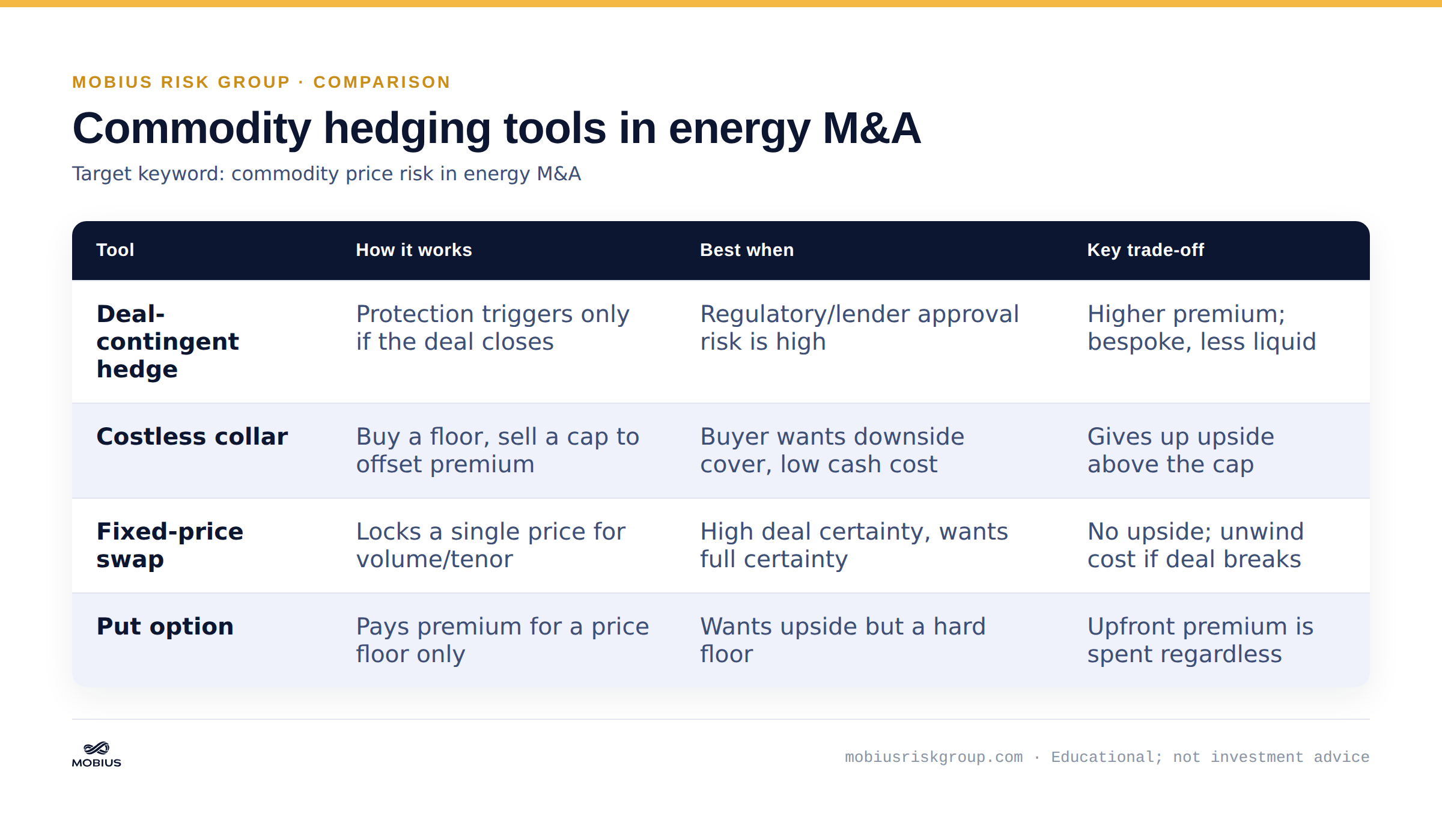
There is no single instrument that fits every transaction. The right structure depends on the probability the deal closes, the liquidity of the underlying commodity, and how much premium the sponsor is willing to spend to protect the equity check. The comparison below outlines the main approaches deal teams weigh.
A deal-contingent hedge is often the headline tool because it only pays—and only costs—if the transaction actually closes, removing the awkward scenario of paying for protection on a deal that falls through. But collars, swaps, and simple puts all have a place depending on cost tolerance and certainty.
How does an independent advisor change the outcome?
Banks and brokers that sell hedging instruments have a structural incentive in the structure they recommend. An advisor that does not take the other side of the trade—or earn a spread on it—can price indicative levels, run the competitive process, and tell a sponsor when the cheapest protection is simply to walk. Mobius’s M-Direct indicative pricing and unconflicted model are built for exactly this seat at the table.
For PE and strategic buyers, that independence compounds across a portfolio: a consistent, unconflicted risk framework applied deal after deal produces cleaner valuations, fewer surprises at close, and a defensible story for the investment committee.
Related reading from Mobius Risk Group
Continue with how a deal-contingent hedge works; an unconflicted commodity risk advisor; natural gas hedging strategies.
Frequently asked questions
What is a deal-contingent hedge?
A deal-contingent hedge is a derivative that only becomes effective if a specified transaction closes. If the deal collapses, the hedge terminates with no cost to the buyer, which is why it is popular for acquisitions facing regulatory or financing uncertainty.
When should a buyer hedge in an energy acquisition?
Most buyers evaluate hedging as soon as a purchase agreement is signed, because that is when price exposure between signing and closing begins. The decision weighs the probability the deal closes, commodity volatility, and how much of the equity value depends on the forward curve.
Why use an independent advisor instead of the deal bank?
A bank that also sells the hedge earns on the structure it recommends. An unconflicted advisor prices the market, runs a competitive process, and can advise against hedging when protection is overpriced—aligning purely with the buyer’s outcome.
Subscribe to receive the latest Mobius Research & updates