
August 27, 2026
Quick answer: Hedge accounting under ASC 815 is an elective accounting treatment that lets a company match the gains and losses on a qualifying derivative to the earnings impact of the exposure it hedges. Applied correctly, it removes the mark-to-market swings that would otherwise distort reported earnings each quarter.
For a CFO or treasurer running an energy hedging program, the economics of a hedge and its accounting treatment are two different problems. A swap or collar can perfectly offset a physical exposure and still create quarter-to-quarter earnings noise if the derivative is marked to market while the hedged item is not. Hedge accounting under ASC 815 is the mechanism that closes that gap. Because election is optional and documentation-heavy, many companies leave the benefit on the table or discover a program does not qualify only after the fact.
What is hedge accounting under ASC 815?
ASC 815 (formerly FAS 133) is the U.S. GAAP standard that governs derivatives and hedging. By default, every derivative is carried on the balance sheet at fair value, with changes flowing straight through the income statement. Hedge accounting is an elective exception: when a derivative is formally designated and documented as a hedge of a specific exposure, ASC 815 lets the company defer or reclassify those fair-value changes so they land in earnings in the same period as the item being hedged. The result is reported earnings that reflect the economic hedge rather than the timing mismatch.
What are the three types of hedges ASC 815 recognizes?
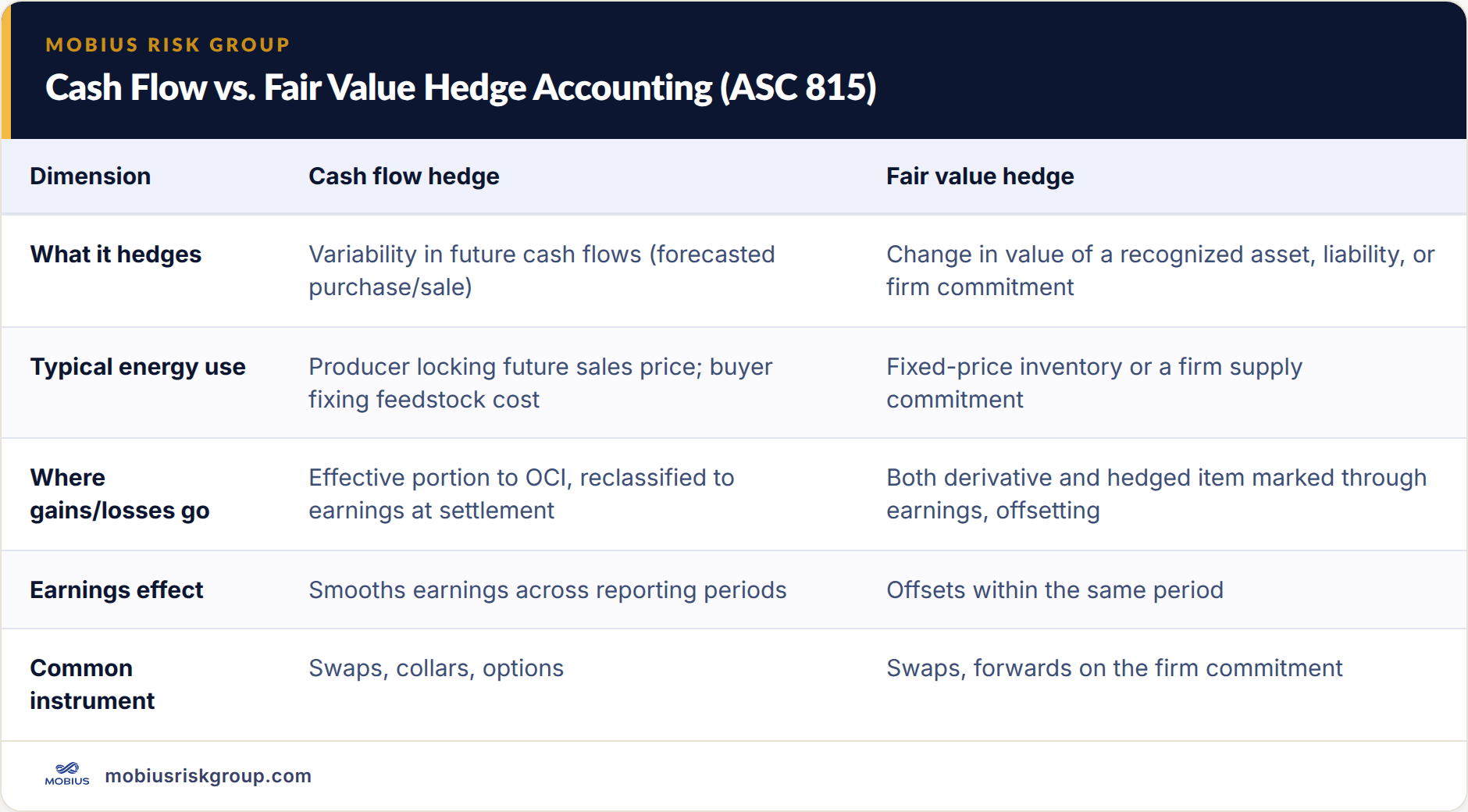
The standard defines three designations. A cash flow hedge covers variability in expected future cash flows — for example, a producer locking a floating gas price or a manufacturer fixing future feedstock cost; the effective portion is parked in other comprehensive income (OCI) and released to earnings when the forecast transaction settles. A fair value hedge offsets changes in the value of a recognized asset, liability, or firm commitment, such as fixed-price inventory. A net investment hedge addresses currency exposure in a foreign operation. Most energy price-risk programs use cash flow hedges.
Why does hedge accounting matter for energy companies?
Energy exposures are large, volatile, and often span multiple reporting periods, so the mismatch ASC 815 solves is acute. Without hedge accounting, a company that has economically locked its margin can still report a loss on its derivatives in a quarter where prices move against the paper position — even though the offsetting benefit on the physical side has not yet been recognized. That noise complicates covenant compliance, analyst guidance, and board conversations. Hedge accounting keeps reported earnings aligned with the risk-management intent, which is why lenders and boards frequently expect it for a formal hedging program.
How do you qualify for and maintain hedge accounting?
Qualification is procedural and unforgiving. At inception the company must formally designate the hedge, document the risk-management objective and strategy, identify the hedging instrument and the hedged item, and describe how effectiveness will be assessed. The hedge must be expected to be highly effective, and effectiveness has to be assessed at least quarterly. ASC 2017-12 simplified several mechanics — easing the old “shortcut” and long-haul rules and allowing qualitative assessments in some cases — but the discipline of contemporaneous documentation remains. Miss the documentation at inception and the election is lost for that relationship; there is no retroactive fix.
Cash Flow vs. Fair Value Hedge Accounting (ASC 815)
Related reading: how a costless collar works; what a commodity hedging policy should include; natural gas hedging strategies for CFOs and treasurers.
Frequently asked questions
Is hedge accounting required?
No. It is an elective treatment under ASC 815. A company can hedge economically without electing it, but then derivative fair-value changes flow through earnings each period, creating volatility that hedge accounting is designed to remove.
What happens if a hedge becomes ineffective?
The ineffective portion of a cash flow hedge is recognized in earnings immediately. If the hedge no longer qualifies as highly effective, hedge accounting must be discontinued prospectively, and amounts already in OCI are released as the original forecast transaction affects earnings (or immediately if it is no longer expected to occur).
Does ASC 815 apply to physical commodity contracts?
Physical contracts that qualify for the normal purchases and normal sales (NPNS) scope exception are excluded from derivative accounting. Whether a contract qualifies depends on net settlement and delivery terms, which is a common area of judgment for energy companies.
Can an independent advisor help with hedge accounting?
An unconflicted advisor can structure hedges that are both economically sound and designable under ASC 815, and coordinate the inception documentation and effectiveness testing your auditors will require — without the conflict of also selling you the derivative.
Mobius Risk Group advises energy producers, industrial buyers, and their finance teams on hedging programs that stand up to both market stress and audit scrutiny — as an independent, unconflicted advisor with no derivative inventory to sell.
Subscribe to receive the latest Mobius Research & updates