
August 27, 2026
Quick answer: A three-way collar is an oil and gas hedge built from three options: a purchased put (the floor), a sold call (the ceiling), and a second sold put below the floor. The sold put lowers the hedge's cost or raises the ceiling, but it re-exposes the producer to prices below the lower strike — trading downside protection for improved terms.
Producers reach for a three-way collar when a plain collar's economics feel too tight — the ceiling too low, or the structure carrying a premium they would rather avoid. By selling a second, lower put, the producer collects extra premium to spend on better strikes. The trade is popular precisely because it looks like a free upgrade, and it is anything but: the third leg quietly hands back downside protection in exactly the price environment where a producer needs it most. Understanding that trade-off is the whole point.
How does a three-way collar work?
Start with a standard collar: a producer buys a put to set a price floor and sells a call to cap the upside, using the call premium to pay for the put. A three-way collar adds a third leg — the producer also sells a put at a lower strike. That sold put generates additional premium, which is used either to raise the call strike (more upside participation) or to reduce or eliminate the net cost of the structure. The producer is protected between the two put strikes, but below the lower put they are effectively unhedged again.
What does the payoff look like at settlement?
Between the long put strike and the short call strike, the producer realizes roughly the market price — the collar behaves normally. Above the call strike, upside is capped. The difference appears at the bottom: below the long put, the producer is protected only down to the short put strike. Once price falls through that lower strike, the long and short puts offset, and the producer is exposed to further declines dollar-for-dollar, as if unhedged — while still receiving the difference between the two put strikes as a fixed cushion.
When does a three-way collar make sense — and when not?
It fits a producer with a constructive-to-neutral price view who wants better upside or lower cost and judges a crash below the lower strike unlikely. It is a poor fit when downside protection is the entire reason for hedging — for a highly levered producer or one with tight covenants, re-exposure in a price collapse can be exactly the scenario that breaks the business. The structure's appeal rises when volatility is high (fatter put premiums to harvest), which is also when tail moves are most likely. That tension is why the third leg deserves scrutiny, not a reflex.
How does a three-way collar compare to a costless collar?
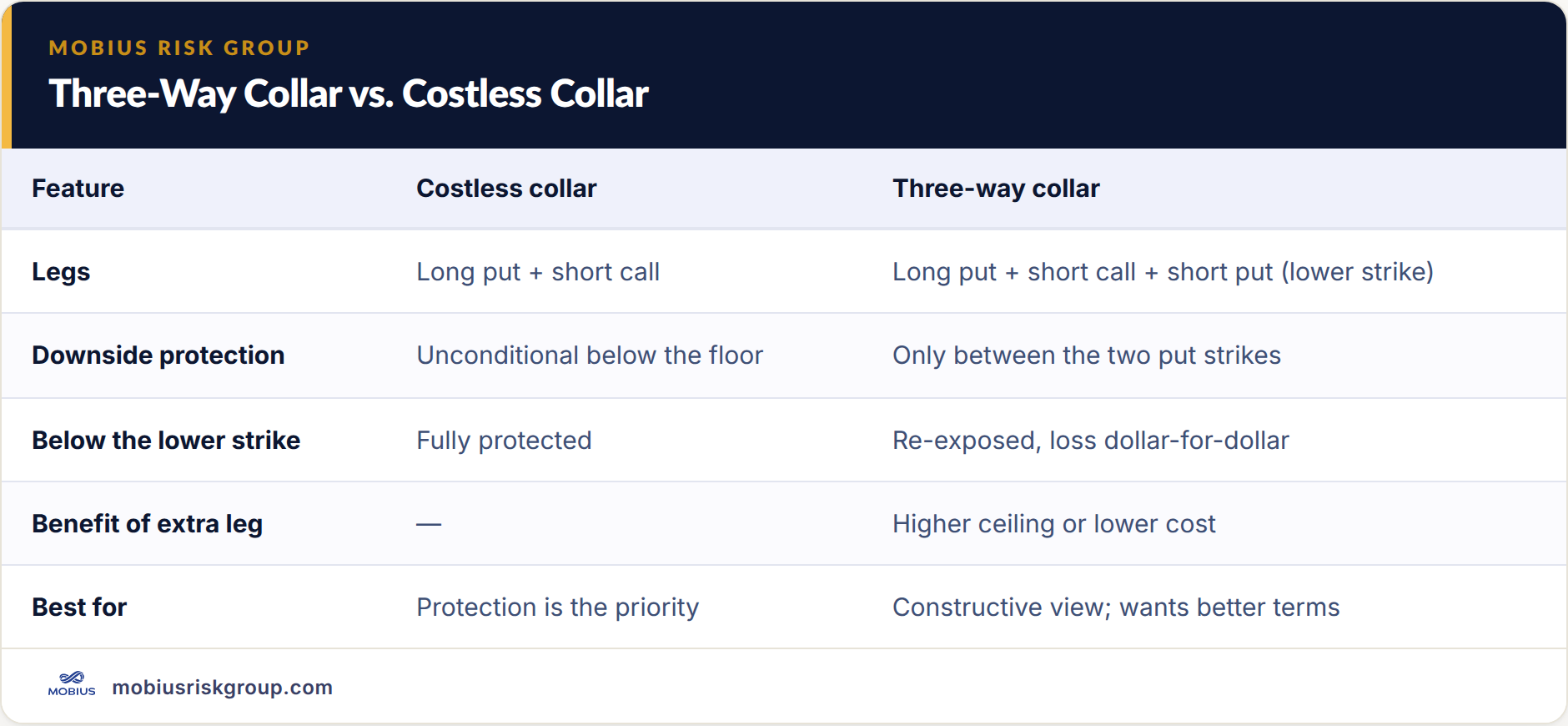
A costless collar gives unconditional protection below its floor — the floor holds no matter how far prices fall. A three-way collar improves the ceiling or cost but caps how much protection the floor provides, reintroducing unlimited downside below the short put. The three-way is not strictly better or worse; it is a different risk profile that trades tail protection for term. The right choice depends on balance-sheet capacity to absorb a low-price tail, not on which structure looks cheaper on the day.
Three-Way Collar vs. Costless Collar
Related reading: what a costless collar is; swaps vs. options for commodity hedging; how much of your production to hedge.
Frequently asked questions
Why would a producer give up downside protection?
To improve the rest of the structure — a higher call strike for more upside, or a lower or zero net premium. The producer is betting that prices will not fall below the short put strike; if that view is wrong, the give-up is costly.
Is a three-way collar the same as a costless collar?
No. A costless collar has two legs and protects unconditionally below its floor. A three-way collar adds a sold put that caps how far the protection extends, re-exposing the producer below the lower strike.
What is the main risk of a three-way collar?
A sharp price decline below the short put strike. There, the hedge stops protecting and the producer absorbs further losses as if unhedged, keeping only the fixed cushion between the two put strikes.
How can an advisor help evaluate a three-way collar?
An unconflicted advisor models the structure against the producer's actual budget, debt, and covenant thresholds — stress-testing the low-price tail — rather than marketing the structure that generates the most trading margin.
Mobius Risk Group helps producers weigh structures like the three-way collar against their real balance-sheet capacity — as an independent advisor whose only interest is the producer's outcome, not the trade.
Subscribe to receive the latest Mobius Research & updates