
August 26, 2026
Quick answer: A three-way collar is an oil or gas hedge built from three options: a purchased put (the floor), a sold call (the ceiling), and a sold lower put (a sub-floor). Selling the lower put funds a higher floor or a net credit, but it caps protection if prices fall below that sub-floor.
How does a three-way collar work?
A producer starts with a collar: buy a put to set a price floor, sell a call to set a ceiling, and use the call premium to offset the put cost. In a three-way collar, the producer also sells a second, lower-strike put. That extra premium either raises the effective floor, generates a net credit, or both — but it re-exposes the producer to price risk below the lower put's strike.
Put simply: between the two put strikes you are fully protected; below the lower put you are effectively unhedged again, because the put you sold offsets the put you bought.
Three-way collar vs. costless collar: which is better?
Neither is universally better — it's a trade-off between floor level and tail protection.
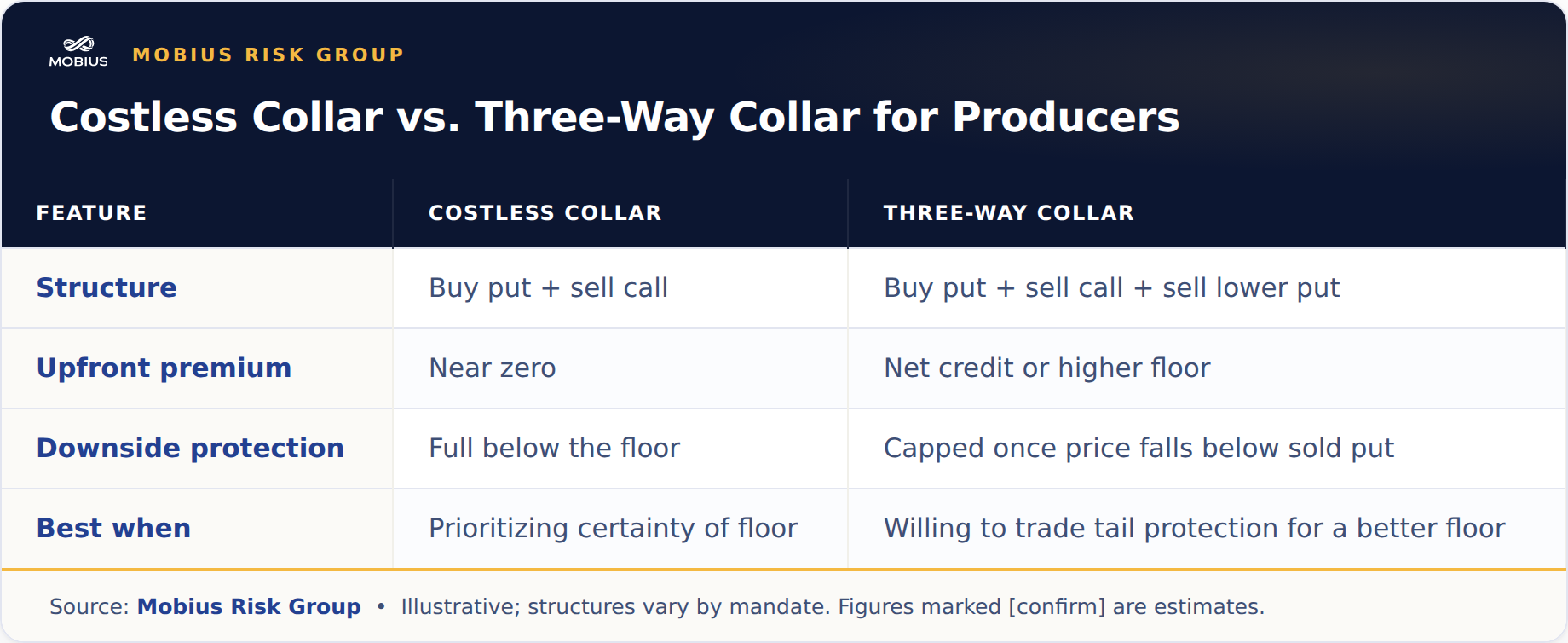
If certainty of the floor matters most, a costless collar is cleaner. If you want a higher floor or upfront credit and believe a catastrophic price collapse is unlikely, the three-way adds yield at the cost of deep-downside cover.
When does a three-way collar make sense for a producer?
Three-ways are most common when a producer wants a better-looking floor than a costless collar allows in the current volatility environment, is comfortable that prices are unlikely to crash through the lower strike, and may need hedge economics that satisfy a lender or reserve-based facility. They are riskier in genuinely volatile or oversupplied markets, where the very scenario the sub-floor exposes you to becomes more likely. For the full toolkit, see crude oil hedging strategies for producers and how swaps compare with options.
What are the main risks of a three-way collar?
The defining risk is the gap below the sold put: if the market falls sharply, realized prices track the market down from the sub-floor, and the hedge no longer protects margin. There is also opportunity cost from the sold call ceiling and margin/credit considerations on the short options. These structures should be sized to a hedging policy, not layered ad hoc.
How Mobius helps producers structure collars
As an unconflicted advisor, Mobius Risk Group models three-way and costless collars against a producer's actual production, debt covenants, and risk tolerance — then values and monitors them in RiskNet so the mark-to-market and downside exposure stay visible. We don't earn a spread on the trade, so the recommendation is driven by your margin protection, not ours.
Frequently asked questions
Is a three-way collar zero-cost?
It can be structured for zero cost or a net credit, but 'zero-cost' does not mean zero-risk — the premium comes from giving up protection below the lower put strike.
What happens if oil falls below the sold put strike?
Below that strike your realized price effectively floats with the market again, so a three-way collar offers no protection in a deep price collapse.
Why would a producer choose a three-way over a swap?
A swap fixes price and gives up all upside; a three-way keeps some upside to the call ceiling and can raise the floor, at the cost of deep-downside protection.
Are three-way collars used for natural gas too?
Yes. The same put/call/lower-put structure is applied to natural gas and other commodities, not just crude oil.
Deciding between a collar, three-way, or swap? Mobius Risk Group can model the structures against your production and covenants.
Subscribe to receive the latest Mobius Research & updates